
Artificial Intelligence vs Machine Learning: Understanding the Key Differences
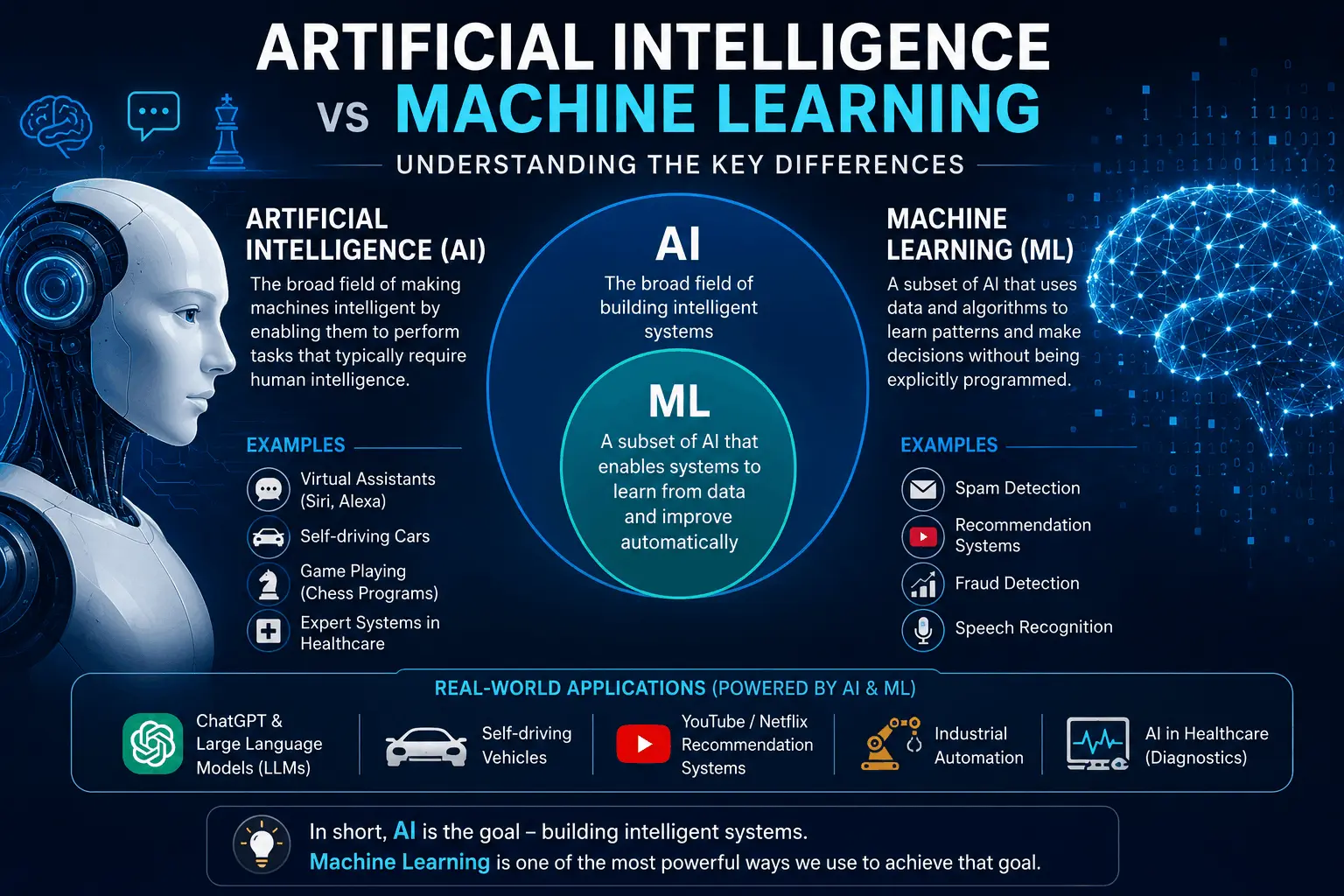
AI vs Machine Learning: Understanding the Real Difference
Introduction
Two of the most commonly heard terms in the technology world today are Artificial Intelligence (AI) and Machine Learning (ML). Because these terms are frequently used interchangeably in marketing campaigns and social media, many people assume they mean the same thing.
However, from a technical perspective, there is a clear distinction between them. The simplest rule is this: Every Machine Learning technology is part of AI, but not every AI system is Machine Learning.
This document explains the real difference between AI and ML, and how they are related, in a technically accurate yet simple way.
What is Artificial Intelligence (AI)?
Artificial Intelligence (AI) is not a single technology. It is a broad field of study. AI refers to enabling computer systems or machines to perform cognitive functions typically associated with human intelligence, such as reasoning, pattern recognition, learning, and decision-making.
Two of the most common approaches used to build AI systems are Rule-based Systems and Learning-based Systems.
1. Rule-based Systems
In this approach, the system does not think independently. A programmer defines how the system should behave by writing if-else conditions and hard-coded rules in advance.
Examples: Early chess-playing computer programs and Expert Systems.
2. Learning-based Systems
Instead of explicitly defining rules for every scenario, the system is provided with data and allowed to learn from it automatically. This learning process is known as Machine Learning.
What is Machine Learning (ML)?
Machine Learning is a subset of the broader field of Artificial Intelligence.
Rather than explicitly programming every step of behavior, ML uses large amounts of data and statistical algorithms to train computers to automatically identify patterns and make predictions or decisions.
Example
In early spam filters, a rule-based AI system could be programmed with hundreds of if-else rules to detect words such as 'Offer' or 'Free'.
In contrast, a Machine Learning system is trained using millions of emails, allowing algorithms to automatically identify common patterns and characteristics of spam messages.
Key Differences Between AI and ML
Artificial Intelligence (AI)
• Overall goal: Create systems that simulate human intelligence.
• Scope: A broad field of study.
• Operation: Can be rule-based or learning-based.
• Programming: May rely entirely on explicitly defined rules.
Machine Learning (ML)
• Overall goal: Enable systems to learn and improve automatically from data.
• Scope: A subset of AI.
• Operation: Primarily based on statistical models and mathematical algorithms such as Linear Regression, Decision Trees, and Neural Networks.
• Programming: Learns patterns from data, reducing the need for continuously writing new rules.
Summary
In simple terms, AI is the destination or ultimate goal—creating intelligent systems. Machine Learning is one of the primary methods or vehicles used to reach that goal.
Modern technologies such as ChatGPT and other Large Language Models (LLMs), self-driving vehicles, and recommendation systems used by platforms like YouTube and Netflix demonstrate how Machine Learning and its advanced form, Deep Learning, are applied to achieve practical Artificial Intelligence solutions.